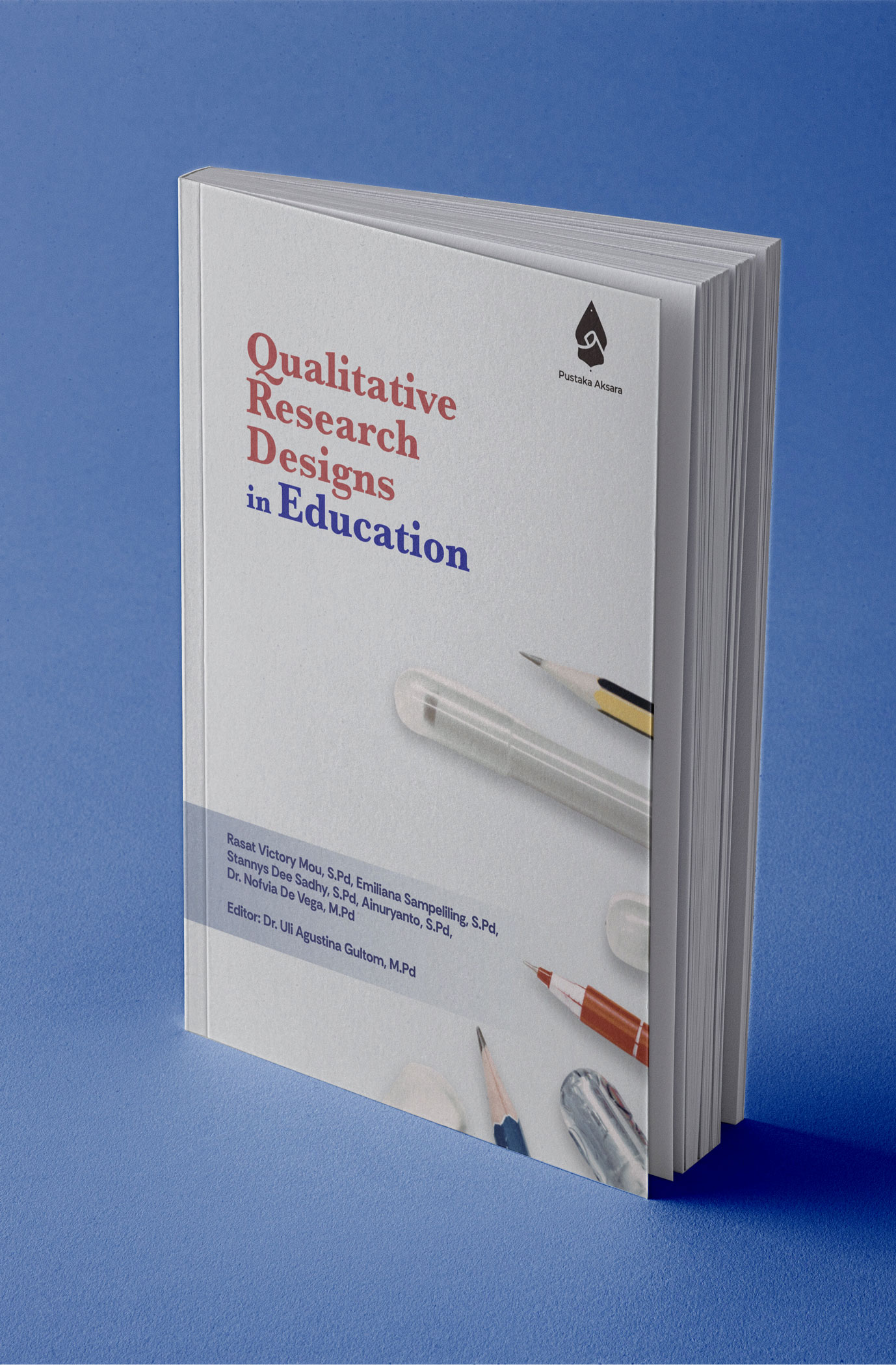
QUALITATIVE RESEARCH DESIGNS IN EDUCATION
Rp. 111.000
Penulis: Rasat Victory Mou, S.Pd,Emiliana Sampeliling, S.Pd,Stannys Dee Sadhy, S.Pd,Ainuryanto, S.Pd, Dr. Nofvia De Vega, M.Pd
Panjang: 23
Lebar: 15
Halaman: 152
ISBN: 9786231616456
Sinopsis:
Qualitative Research Designs in Education provides a comprehensive introduction to key qualitative research traditions used to explore educational phenomena as socially situated, culturally embedded, and meaningfully experienced. The book is organized around four major qualitative designs, each presented as a distinct yet complementary approach to understanding teaching, learning, and schooling. Chapter I: Ethnography in Educational Research introduces ethnography as an interpretive research tradition rooted in the study of culture, meaning, and social practice. The chapter examines how ethnographic research conceptualizes culture as dynamic and negotiated, emphasizing participant observation, prolonged field engagement, and multiple data sources. Key analytical concepts such as emic and etic perspectives are discussed, along with ethical reflexivity in long-term educational research. Through educational examples, the chapter demonstrates how ethnography reveals the cultural dimensions of classroom life and schooling. Chapter II: Case Study Research in Education explores case study research as a powerful approach for investigating bounded educational phenomena within real-life contexts. The chapter explains the defining features of case studies, including contextual depth, triangulation of data sources, and interpretive analysis. Different types of case studies intrinsic, instrumental, and collective are discussed in relation to research purpose and case selection. Detailed attention is given to data sources such as interviews, documents, and observations, as well as to systematic steps in conducting and analyzing case study research. Practical examples illustrate how case studies contribute rich, context-sensitive understanding of educational practice. Chapter III: Narrative Inquiry in Education focuses on narrative inquiry as a human-centered qualitative approach that treats stories as both data and a way of knowing. The chapter examines storytelling as a means of meaning-making, identity construction, and temporal understanding of experience. Forms of narrative data, including life histories, biographies, and personal narratives, are discussed alongside strategies for narrative analysis and structuring research texts. An applied example from EFL teacher education demonstrates how narrative inquiry illuminates professional identity, intercultural experience, and educational change over time. Chapter IV: Phenomenology in Education presents phenomenology as a qualitative approach dedicated to understanding lived experience and the meanings individuals assign to educational phenomena. The chapter outlines the philosophical foundations of phenomenology, explains its purposes in educational research, and distinguishes between major types of phenomenological inquiry. It discusses data collection methods such as in-depth interviews and reflective writing, as well as analytical processes aimed at capturing the essence of experience. The chapter highlights how phenomenological research contributes deep insight into learners’ and teachers’ experiences that may remain inaccessible through other approaches. Taken together, the chapters position qualitative research as an interpretive, contextual, and ethically grounded form of inquiry. Rather than seeking generalization or prediction, the book emphasizes understanding, meaning, and depth. By integrating theory, methodological guidance, and educational examples, Qualitative Research Designs in Education equips readers with the conceptual tools and practical insight necessary to design, conduct, and interpret qualitative research responsibly within diverse educational contexts